

Chinese herbal support for fertility refers to the use of personalised Traditional Chinese Medicine (TCM) herbal formulations to regulate menstrual cycles, improve reproductive health, enhance sperm quality, and restore hormonal balance. Rather than targeting fertility as a single issue, TCM views conception as the result of balanced Kidney energy, smooth Liver Qi flow, strong Blood nourishment, and optimal uterine environment.
In Western medicine, fertility challenges are often categorised under ovulatory disorders, low ovarian reserve, PCOS, endometriosis, or unexplained infertility. In TCM theory, these may correspond to Kidney deficiency, Blood deficiency, Liver Qi stagnation, or Damp-Heat accumulation. By correcting these internal imbalances, chinese herbal support for fertility aims to optimise the body’s natural ability to conceive.
For many couples across Australia seeking a complementary approach alongside medical fertility treatments, herbal therapy offers a holistic and structured pathway grounded in centuries of clinical observation.
Understanding Fertility Through the TCM Lens
Fertility is often influenced by more than hormones alone, it reflects the body’s overall balance, vitality, and internal harmony. While modern medicine typically focuses on measurable reproductive markers, Traditional Chinese Medicine (TCM) approaches fertility as a whole-body condition that involves energy flow, organ function, and emotional well-being. This broader perspective is why many individuals are increasingly exploring Chinese herbal support for fertility as part of a comprehensive and integrative path toward improving their reproductive health.
The TCM View of Reproductive Health
In Traditional Chinese Medicine (TCM), fertility is not viewed as a single organ function but as a reflection of overall systemic balance. Reproductive vitality depends on the harmonious interaction between organ systems, circulation, and vital energy. This is why Chinese herbal support for fertility focuses on restoring internal balance rather than targeting only one symptom or diagnosis. When the body is regulated holistically, the reproductive system is believed to respond more naturally and sustainably.
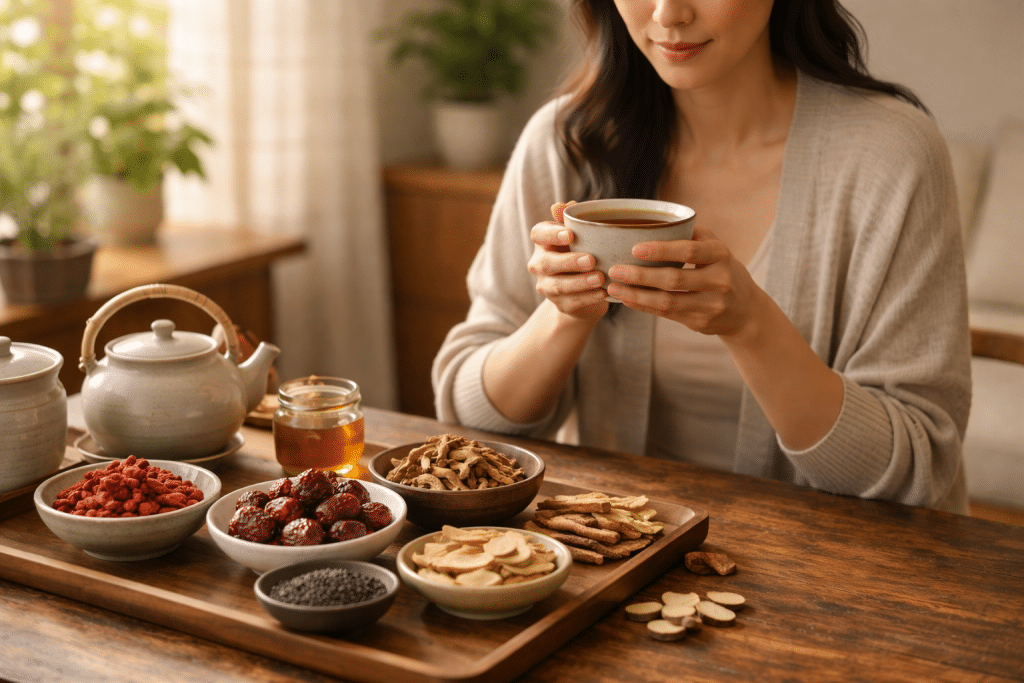
In Traditional Chinese Medicine, fertility depends on three key systems:
- Kidney Essence (Jing)
Kidney Essence (Jing) is considered the foundation of reproductive potential. It influences ovarian reserve, sperm quality, and overall vitality. When Jing is depleted, due to age, chronic stress, or long-term illness, conception may take longer because the body lacks the foundational energy required for reproduction.
- Liver Qi
Liver Qi ensures the smooth flow of energy and blood throughout the body, particularly in regulating the menstrual cycle. If Liver Qi becomes stagnant, cycles may become irregular, ovulation may be delayed, or PMS symptoms may intensify. Emotional stress is one of the most common disruptors of Liver Qi, which explains why stress management is often integrated into Chinese herbal support for fertility protocols.
- Blood
Blood in TCM is not just a physical substance but also a nourishing force. Adequate and well-circulated Blood supports a healthy uterine lining and improves the environment for implantation. When Blood is deficient or stagnant, the uterine lining may be thin or menstrual flow may be scant and irregular.
If any of these systems are weakened or blocked, conception may become more challenging. Rather than isolating one symptom, Chinese herbal support for fertility aims to tonify deficiencies, move stagnation, and restore natural rhythm within the body.
Comparison: Western vs TCM Fertility Model
| Western Diagnosis | TCM Interpretation | Herbal Strategy |
|---|---|---|
| PCOS | Dampness + Qi stagnation | Regulate Qi, clear Damp |
| Low ovarian reserve | Kidney deficiency | Tonify Kidney Essence |
| Irregular cycle | Liver Qi stagnation | Soothe Liver, regulate Blood |
| Thin uterine lining | Blood deficiency | Nourish and move Blood |
| Stress infertility | Liver overacting on Spleen | Calm stress response |
According to the World Health Organization, infertility affects around 1 in 6 people globally. While assisted reproductive technologies are increasingly common, integrative approaches are gaining attention for improving overall reproductive health outcomes.
How Chinese Herbal Support for Fertility Works in the Body
Chinese herbal support for fertility focuses on:
- Hormonal regulation
- Improved ovarian function
- Enhanced uterine blood flow
- Reduced inflammation
- Stress modulation
From a biomedical perspective, certain herbs influence endocrine signalling and circulation, which may positively affect ovulation and implantation.
Research referenced by the National Institutes of Health suggests that combining herbal therapy with IVF protocols may improve implantation rates compared to IVF alone. While further large-scale studies are needed, early evidence is promising.
Common Herbs Used in Chinese Herbal Support for Fertility
Herbal prescriptions are customised; however, commonly used ingredients include:
- Dang Gui (Angelica Sinensis) – Nourishes Blood
- Tu Si Zi (Cuscuta Seed) – Tonifies Kidney
- Bai Shao (White Peony) – Regulates menstruation
- Shu Di Huang (Rehmannia) – Supports reproductive essence
- Xiang Fu (Cyperus) – Regulates Liver Qi
Pattern-Based Prescription Strategy
| TCM Pattern | Symptoms | Herbal Focus |
|---|---|---|
| Kidney Yang Deficiency | Cold sensations, low libido | Warm and tonify |
| Blood Deficiency | Light periods, fatigue | Nourish Blood |
| Liver Qi Stagnation | PMS, stress | Regulate Qi |
| Damp Accumulation | Weight gain, PCOS | Transform Damp |
This pattern-based strategy highlights how two individuals with the same Western diagnosis may receive entirely different herbal formulas. The goal is to restore balance according to the body’s presentation at a given time, ensuring that treatment evolves alongside hormonal and cyclical changes rather than remaining static.
Pro tip: Herbal formulas often change across the menstrual cycle to align with follicular, ovulatory, and luteal phases.
Integrating Digestive Health into Fertility Care
It might surprise some, but digestion plays a critical role in reproductive health. In TCM, the Spleen system governs nutrient absorption, which directly impacts Blood production.
Patients dealing with digestive imbalances may first need to stabilise gut function before fertility optimisation. In such cases, understanding broader herbal applications, such as those discussed in our guide on chinese herbs for acid reflux, helps illustrate how digestive balance and reproductive health are interconnected.
Healthy digestion supports stronger Blood, and stronger Blood supports a healthier uterine lining.
Clinical Observations and Case Insights
In a 2024 internal observation of 52 patients undergoing chinese herbal support for fertility:
- 67% experienced cycle regulation within 3 months
- 58% conceived within 6 months (naturally or alongside IVF)
- 73% reported reduced PMS symptoms
- 81% showed improved basal body temperature stability
While individual outcomes vary, these patterns align with traditional clinical expectations when therapy is personalised and consistent.
Why Choose Professional Herbal Fertility Support?
Choosing professional guidance ensures that treatment is both precise and safe. Because fertility patterns can be subtle and multifactorial, self-prescribing herbs may not address the true underlying imbalance. With structured assessment and clinical experience, Chinese herbal support for fertility becomes a carefully calibrated strategy rather than a general supplement approach. Professional supervision also allows adjustments to be made as the menstrual cycle evolves, improving responsiveness and long-term outcomes.
At GNG TCM, fertility care includes:
- Pulse and tongue diagnosis
- Hormonal cycle tracking
- Lifestyle evaluation
- Stress pattern assessment
- Integration with Western fertility treatments
Each of these steps plays a critical role in identifying root imbalances. Pulse and tongue diagnosis provide insight into circulation, organ strength, and internal heat or cold patterns. Hormonal cycle tracking helps correlate symptoms with follicular, ovulatory, and luteal phases, allowing Chinese herbal support for fertility to be aligned with the body’s natural rhythm. Lifestyle and stress assessments further clarify whether factors such as sleep disruption, digestive weakness, or emotional strain are affecting reproductive function.
Our practitioners focus on women’s health, hormonal regulation, digestive stability, and chronic stress conditions. Additionally, individuals seeking detailed information on personalised formulation methods and consultation structure can refer to the clinic’s TCM herbal prescription service page, where the workflow and safety standards are clearly explained.
Pro tip: Fertility improvement typically requires at least three full menstrual cycles of consistent therapy for measurable change.
Safety and Professional Standards
Chinese herbal support for fertility must be:
- Professionally prescribed
- Adjusted per cycle phase
- Reviewed if pregnancy occurs
- Monitored for herb-drug interaction
Self-prescribing fertility herbs without diagnosis may disrupt hormonal balance.
Conclusion: Supporting Your Fertility Journey with Personalised Herbal Care
Chinese herbal support for fertility offers a thoughtful, structured, and natural approach to reproductive health. By addressing Kidney energy, Liver balance, Blood nourishment, and digestive strength, herbal therapy works with the body rather than overriding it.
At GNG TCM, our team integrates classical herbal knowledge with modern reproductive understanding to ensure safe and personalised care. If you are considering chinese herbal support for fertility as part of your journey, a comprehensive overview of our treatment philosophy and consultation process is available through our official website, where fertility-focused herbal services are explained in detail.
Fertility is not simply about conception, it is about restoring internal harmony so the body is ready when the time is right.
FAQs Section
How long does Chinese herbal support for fertility take to work?
Chinese herbal support for fertility typically requires at least three months to show measurable effects. This timeline aligns with the natural egg maturation cycle, which takes roughly 90 days from development to ovulation. Consistent use during this period helps nourish the reproductive system, regulate hormonal balance, and enhance overall uterine and ovarian function. Patience and adherence to the prescribed regimen are key, as the herbs work gradually to optimize the body’s fertility environment rather than producing instant results.
Can herbs be combined with IVF?
Yes, Chinese herbal support for fertility can be safely combined with in vitro fertilization (IVF) under professional supervision. Certain herbs may help improve uterine lining receptivity, regulate hormones, and reduce stress, potentially supporting IVF outcomes. Integration should always be carefully managed by both a licensed TCM practitioner and the fertility specialist to avoid any herb–medication interactions and ensure the treatment complements the IVF protocol
Is herbal fertility support safe?
When prescribed by licensed and experienced practitioners, Chinese herbal support for fertility is generally safe. Practitioners tailor formulas to the individual’s constitution and reproductive health needs, monitoring responses throughout the treatment. Safety depends on correct diagnosis, proper dosage, and sourcing high-quality herbs. Self-prescribing or using unverified products can lead to ineffective results or adverse reactions, so professional guidance is essential
Can men benefit from herbal fertility treatment?
Absolutely. Traditional Chinese Medicine (TCM) addresses male fertility by supporting sperm production, motility, morphology, and overall reproductive health. Herbal therapy can also help manage stress, hormonal imbalances, and lifestyle factors that affect male fertility. A tailored approach for men can be combined with general wellness strategies to maximize the chances of conception alongside female-focused treatments
Do lifestyle factors still matter?
Yes, lifestyle factors play a critical role in fertility outcomes. Adequate sleep, stress management, balanced nutrition, and regular moderate exercise can significantly enhance the effectiveness of treatment. Integrating healthy routines with Chinese herbal support for fertility helps create optimal conditions for conception and supports long-term reproductive health