

TCM herbs for heatiness are Chinese herbal medicines traditionally used to address patterns of excess internal heat, often described in TCM as “heat” or shanghuo. People may associate heatiness with symptoms such as a sore throat, mouth ulcers, acne, thirst, constipation, or a feeling of being overheated.
In Traditional Chinese Medicine, however, heatiness is not treated as one single condition. The appropriate herbs depend on the pattern behind the symptoms, which is why the same herbal formula may not be suitable for everyone.
What Does “Heatiness” Mean in TCM?
In TCM, heatiness generally refers to an imbalance involving internal heat. It is a traditional TCM concept rather than a diagnosis used in conventional Western medicine, and practitioners look at the overall pattern rather than one symptom alone.
For example, HealthHub Singapore explains that the traditional idea of “heaty” and “cooling” comes from the TCM concepts of yin and yang. Symptoms commonly associated with heatiness include:
- Sore throat
- Mouth ulcers
- Acne or skin breakouts
- Excessive thirst
- Irritability
- Constipation
- Redness of the skin
The idea has been part of Chinese health traditions for more than 2,000 years.
This distinction matters. Having a sore throat after several late nights does not automatically mean that a person needs a “cooling” herb. A TCM practitioner will usually consider other signs before deciding what kind of herbal support is appropriate.
Which TCM Herbs Are Traditionally Used for Heatiness?
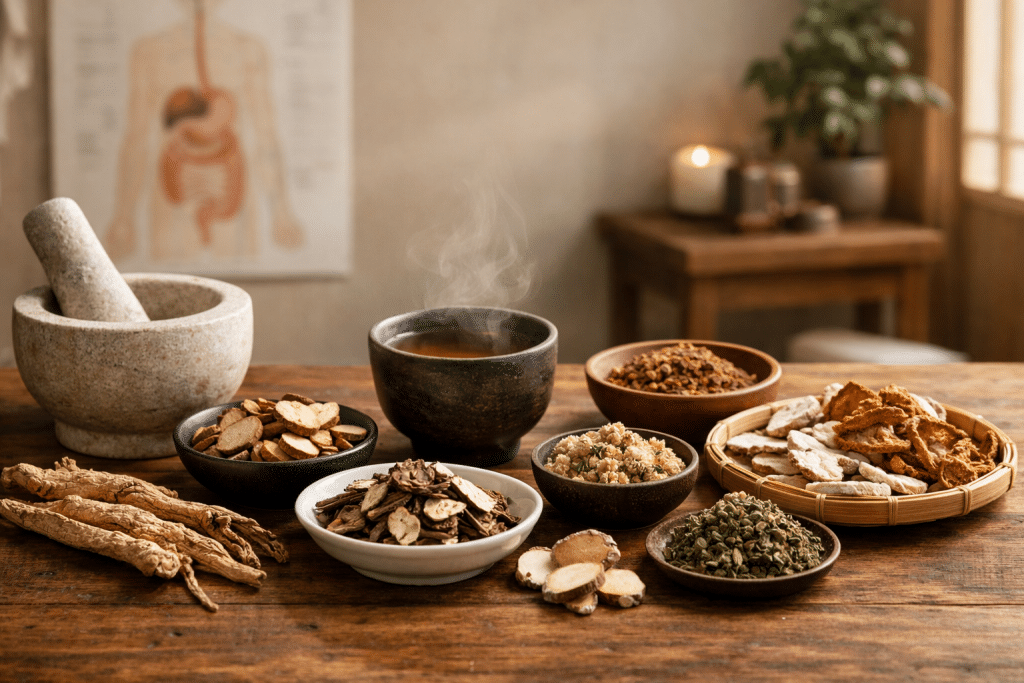
Some Chinese herbs are classified in TCM as heat-clearing herbs. NTU Chinese Medicine describes this group as herbs that primarily clear interior heat, with different herbs traditionally used for different heat patterns.
Examples include:
| TCM herb | Traditional TCM use | Why it may be considered |
|---|---|---|
| Huang Lian (Coptis) | Clearing heat and damp-heat | Traditionally used for certain heat-related patterns |
| Jin Yin Hua (Honeysuckle) | Clearing heat and reducing “fire” | Commonly discussed in heat-clearing formulas |
| Ju Hua (Chrysanthemum) | Clearing heat and supporting the eyes | Traditionally used when heat is associated with eye discomfort |
| Lian Zi (Lotus seed) | Supporting digestive and spleen-related patterns | May be included when other TCM patterns are present |
| Dan Zhu Ye (Lophatherum) | Clearing heat and promoting urination | Used traditionally for particular heat patterns |
These are examples of traditional TCM classifications, not a list of herbs that everyone with heatiness should take. In fact, NTU notes that heat-clearing herbs can be divided into several groups, including those that clear heat and purge fire, clear heat and dry dampness, clear heat and cool the blood, and address deficiency heat.
Why Huang Lian Is Sometimes Discussed for Heatiness
Huang Lian, also known as Rhizoma Coptidis or Coptis, is a useful example of why personalised herbal treatment matters. Traditional TCM texts classify it as a heat-clearing herb, while research has also examined its main compound, berberine.
Its history in Singapore is particularly interesting. A published review describes how Rhizoma Coptidis was traditionally used in the Chinese community in Singapore and discusses its regulatory history and safety concerns.
The lesson is fairly simple: a herb can have a long history of traditional use, but that does not mean it should be taken casually or in large amounts.
What Symptoms May Suggest a Need for TCM Assessment?
Heatiness is usually discussed in relation to a group of symptoms rather than one isolated complaint.
Clients often ask about TCM when they notice several things happening together, such as:
- Repeated mouth ulcers and thirst
- Acne appearing alongside constipation
- A sore throat after periods of poor sleep
- Feeling unusually warm or restless
- Digestive discomfort with signs traditionally associated with damp-heat
From a TCM perspective, these combinations can provide useful clues. The practitioner may also ask about sleep, appetite, bowel movements, stress, menstrual health, tongue appearance, and other aspects of daily health.
This is one reason it is better to think of TCM herbs for heatiness as part of a personalised treatment approach rather than as a single “cooling herb” solution.
Can You Take Cooling Herbs on Your Own?
It is better not to assume that every cooling or heat-clearing herb is appropriate for you.
Some herbs have pharmacological effects and can interact with medicines. The US National Center for Complementary and Integrative Health (NCCIH) also warns that some Chinese herbal products have been associated with contamination, incorrect ingredients, heavy metals, pesticides, or interactions with medicines.
A simple example is someone who regularly takes prescription medication and decides to add several herbal products because they feel “heaty.” Even if the herbs are traditionally regarded as cooling, the combination may not be appropriate without professional guidance.
For pregnant or breastfeeding individuals, people with existing health conditions, or anyone taking regular medication, discussing herbal use with a qualified healthcare professional is especially important.
How Does a TCM Practitioner Choose an Herbal Formula?
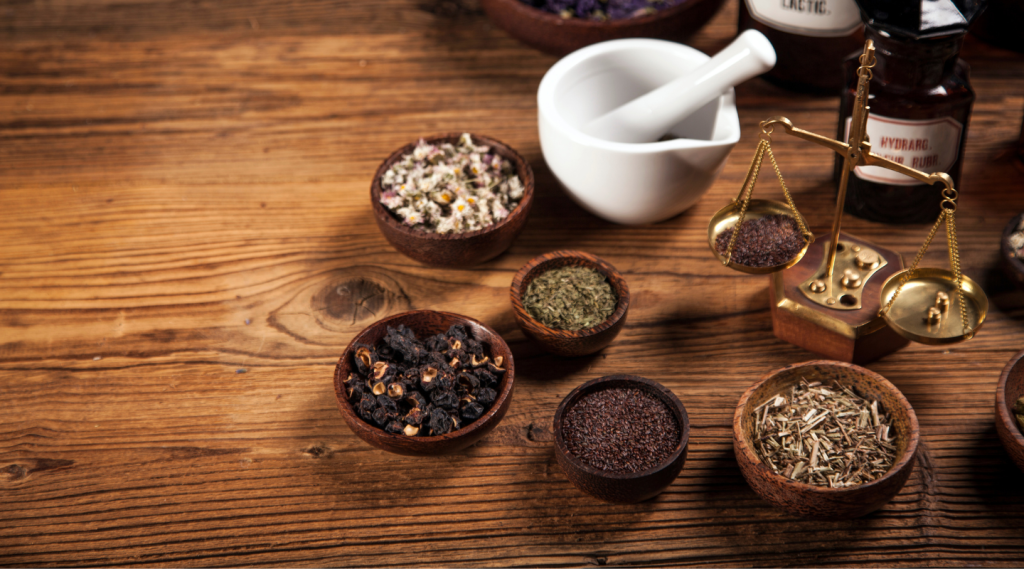
Rather than choosing an herb based only on a symptom, a TCM practitioner generally assesses the person’s overall pattern.
A consultation may involve:
- Discussing the main symptoms
The practitioner asks when the symptoms started, what makes them better or worse, and whether other symptoms are present.
- Looking at the overall TCM pattern
Signs such as digestion, sleep, thirst, bowel movements, energy and other health details may help form a TCM assessment.
- Selecting suitable herbs or a formula
The practitioner considers whether the presentation is more consistent with excess heat, damp-heat, deficiency heat, or another pattern.
- Adjusting the treatment
The herbal prescription may be modified according to how the person responds rather than remaining exactly the same throughout treatment.
At G&G TCM Medical, this type of individual assessment is important because herbal treatment is not simply about finding the strongest “cooling” ingredient. The aim is to match the treatment approach to the person’s overall TCM pattern.
This is why a TCM consultation can be helpful when you are unsure whether your symptoms are related to excess heat or another TCM pattern. A practitioner can assess your symptoms and overall condition before recommending an appropriate herbal approach.
What About Herbal Formulas for Stress and Restlessness?
Not every complaint that people describe as “heatiness” is necessarily an excess-heat pattern. Stress, poor sleep and emotional strain can also affect how a person feels day to day.
For people looking into herbal approaches for relaxation and balance, G&G TCM Medical also provides a calming chinese herbal formula. The purpose and formulation are different from simply taking a heat-clearing herb, which is another reason that treatment should be based on the individual’s needs.
A Simple Real-World Example
Imagine someone in Singapore who has been sleeping five hours a night, eating more spicy and fried food than usual, and then develops a sore throat and several mouth ulcers.
They may search online for “TCM herbs for heatiness” and immediately think they need a strong cooling remedy. A TCM consultation may instead look at the complete picture: diet, sleep, stress, digestion and the pattern of symptoms before deciding whether a heat-clearing approach is suitable.
That small difference — treating the pattern rather than just the symptom — is central to traditional Chinese herbal practice.
How Common Is Research Into TCM in Singapore?
Interest in TCM is not new in Singapore. A recent review of TCM integration in Singapore examined 71 research papers published over the preceding decade, covering acupuncture and Chinese herbal medicine among other areas. The authors noted that clinical effectiveness and cost-effectiveness remain areas of ongoing research.
Research into TCM herbs specifically is more complicated because herbal formulas can contain several ingredients, and traditional indications do not always map neatly onto modern medical diagnoses. NCCIH similarly notes that studies of Chinese herbal products have produced mixed results and that more high-quality research is needed.
So, while traditional use is important for understanding TCM, it should not be presented as proof that a particular herb will treat a medical condition.
Conclusion: Choosing TCM Herbs for Heatiness Safely
TCM herbs for heatiness are traditionally used to help address different patterns of internal heat, but there is no universal cooling herb that works for everyone. The more useful approach is to understand what may be contributing to the symptoms and select herbs or formulas according to the individual’s TCM pattern.
G&G TCM Medical provides Traditional Chinese Medicine consultations and herbal treatment in Singapore, with an approach that considers the person’s symptoms and overall condition. If you are experiencing recurring symptoms associated with heatiness and want to understand whether TCM may be suitable, visit G&G TCM Medical to learn more about the clinic and available TCM services.
FAQs Section
What are the best TCM herbs for heatiness?
There is no single best herb for everyone. TCM practitioners classify different herbs according to their traditional properties and choose them based on the individual’s pattern, symptoms and overall condition.
What are the symptoms of heatiness in TCM?
Commonly described symptoms include sore throat, mouth ulcers, acne, thirst, constipation, irritability and a feeling of internal warmth. Several symptoms occurring together may prompt someone to seek a TCM assessment.
Can I take TCM cooling herbs every day?
Not necessarily. A cooling or heat-clearing herb may not be appropriate for every person or every situation. Herbal products can also interact with medicines, so regular use should ideally be discussed with a qualified practitioner or healthcare professional.
Does drinking herbal tea get rid of heatiness?
Some herbal teas are traditionally used as cooling or heat-clearing drinks, but whether they are suitable depends on the person’s TCM pattern. Drinking a herbal tea should not be treated as a substitute for assessment when symptoms are persistent or severe.
When should I see a TCM practitioner for heatiness?
Consider a consultation when symptoms keep returning, several symptoms occur together, or you are unsure which type of herbal treatment is appropriate. A practitioner can assess the broader pattern rather than choosing an herb based on one symptom alone.