

The most commonly used acupressure points for sleep are Anmian (behind the ear), Shenmen (HT7, inner wrist crease), Neiguan (PC6, inner forearm), Yintang (between the eyebrows), Yongquan (KD1, sole of the foot), Sanyinjiao (SP6, inner lower leg), Taichong (LV3, top of the foot) and Taixi (KD3, inner ankle). Press each point gently but firmly for 1 to 3 minutes while breathing slowly, about 30 minutes before bed. Small studies suggest acupressure can improve sleep quality, but the evidence is still limited. Avoid SP6 during pregnancy, and see a doctor if poor sleep lasts more than three months.
What is acupressure and how can it help you sleep?
Acupressure is a Traditional Chinese Medicine (TCM) technique that uses finger pressure, instead of needles, on the same points used in acupuncture. In TCM, these points sit on meridians that carry qi, and pressing them helps calm the mind (安神, ān shén) and settle the body for rest.
From a modern view, slow, steady pressure combined with deep breathing helps shift the nervous system from “fight or flight” into “rest and digest” mode, which slows the heart rate and eases muscle tension. That makes acupressure a useful, low-cost part of a bedtime routine, especially when stress or an overactive mind keeps you awake.
8 acupressure points for sleep at a glance
| Point | Where it is | Press for | Best for |
|---|---|---|---|
| Anmian (安眠) | Behind the ear, in the hollow behind the bony bump | 2–3 min each side | Trouble falling asleep, racing thoughts |
| Shenmen, HT7 (神门) | Inner wrist crease, pinky-finger side | 1–2 min each wrist | Anxiety, overthinking |
| Neiguan, PC6 (内关) | 3 finger-widths above the inner wrist crease, between the two tendons | 1–2 min each arm | Stress, palpitations, a heavy stomach at night |
| Yintang (印堂) | Midpoint between the eyebrows | 1–2 min | Mental tension, headaches |
| Yongquan, KD1 (涌泉) | Sole of the foot, in the dip just behind the ball of the foot | 1–2 min each foot | Restlessness, feeling “wired” |
| Sanyinjiao, SP6 (三阴交) | 4 finger-widths above the inner ankle bone, behind the shin bone | 1–2 min each leg | Light sleep, cycle-related poor sleep (not in pregnancy) |
| Taichong, LV3 (太冲) | Top of the foot, in the dip between the big toe and second toe bones | 1–2 min each foot | Irritability, stress, tension headaches |
| Taixi, KD3 (太溪) | Inner ankle, in the hollow between the ankle bone and the Achilles tendon | 1–2 min each foot | Waking at night, night sweats, older adults |
How to find and press each point
Use the pad of your thumb or middle finger. Press firmly enough to feel a dull ache or warmth, but never sharp pain. Small circles or steady pressure both work. Breathe in for 4 counts and out for 6 counts while you press.
1. Anmian (安眠, “Peaceful Sleep”)
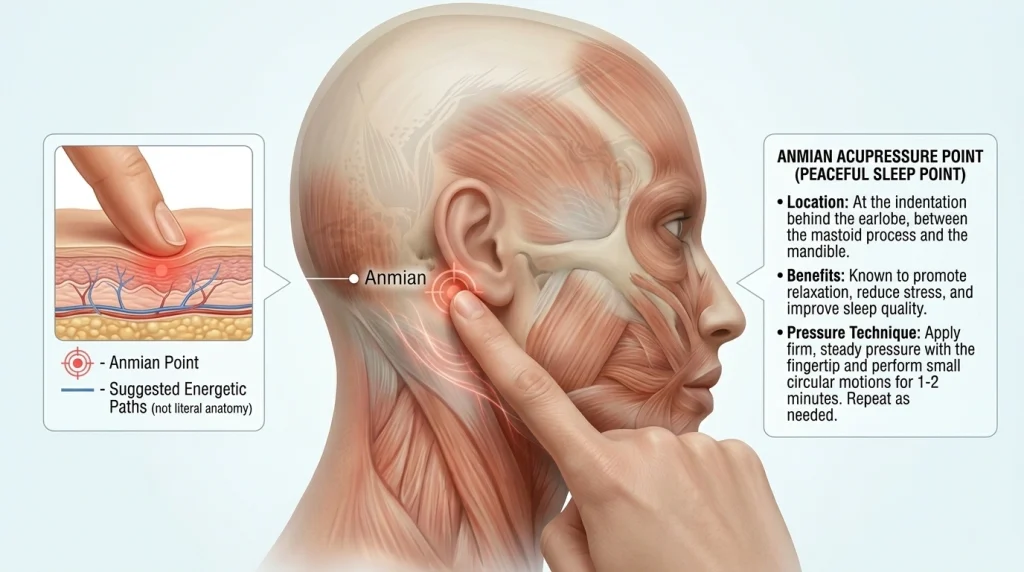
How to find it: place a finger on your earlobe, slide it back to the bony bump behind the ear (the mastoid), then move it slightly down and back into the soft hollow at the base of the skull.
How to press: gentle circles for 1 to 2 minutes on both sides, ideally lying down. Anmian is an “extra point” used in TCM specifically for insomnia, and it is a good first point to learn.
2. Shenmen, HT7 (神门, “Spirit Gate”)
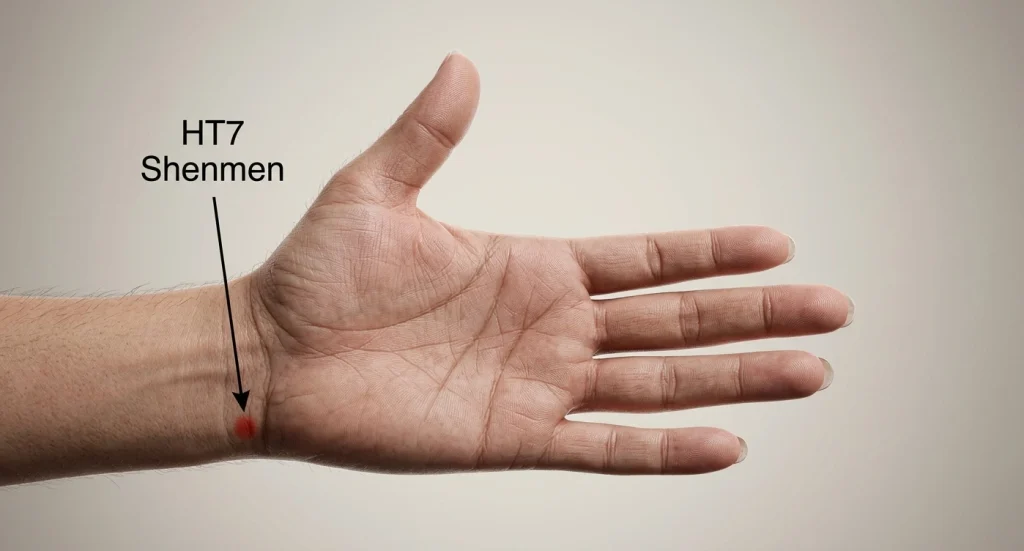
How to find it: bend your wrist slightly to show the crease. Shenmen is at the end of the crease on the pinky-finger side, in the small hollow next to the tendon.
How to press: use the opposite thumb for 1 to 2 minutes on each wrist. In TCM, HT7 calms the Heart and the shen (mind), so it suits nights when worry or overthinking keeps you awake.
3. Neiguan, PC6 (内关, “Inner Gate”)
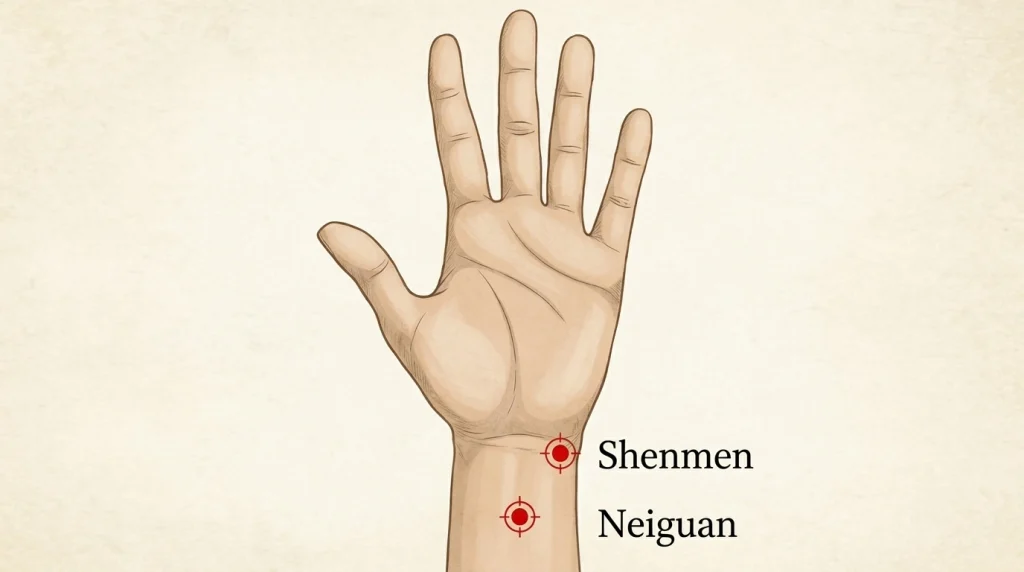
How to find it: place three fingers across your inner wrist, starting at the crease. PC6 is just above your third finger, between the two tendons in the middle of the forearm.
How to press: firm, steady pressure for 1 to 2 minutes on each arm. PC6 is used for anxiety and a tight chest, and also for nausea or a heavy stomach after a late dinner.
4. Yintang (印堂, “Hall of Impression”)
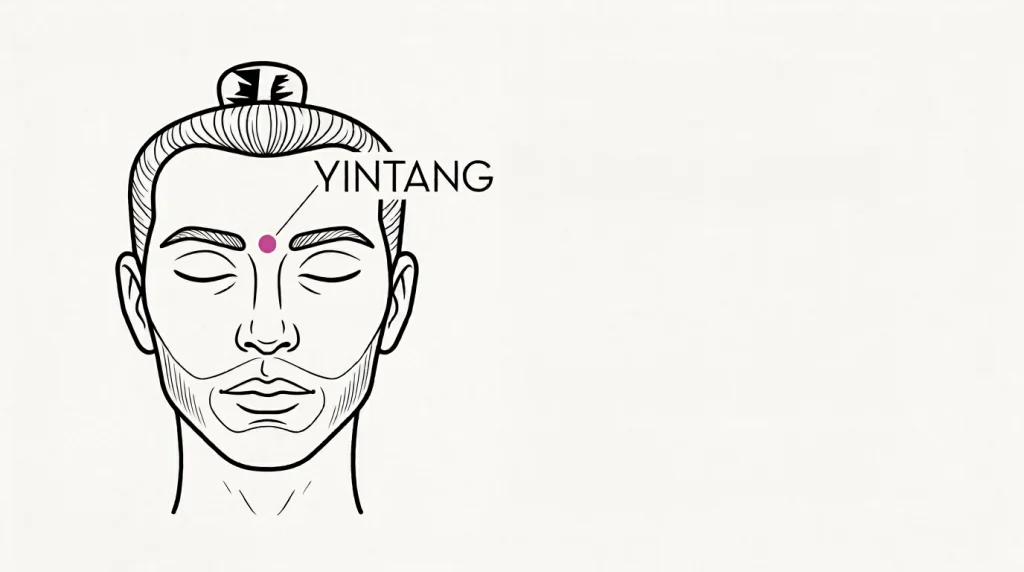
How to find it: the midpoint between your eyebrows, just above the bridge of the nose.
How to press: light circles with your middle finger for 1 to 2 minutes, eyes closed. This is one of the gentlest points and is often combined with Shenmen.
5. Yongquan, KD1 (涌泉, “Bubbling Spring”)
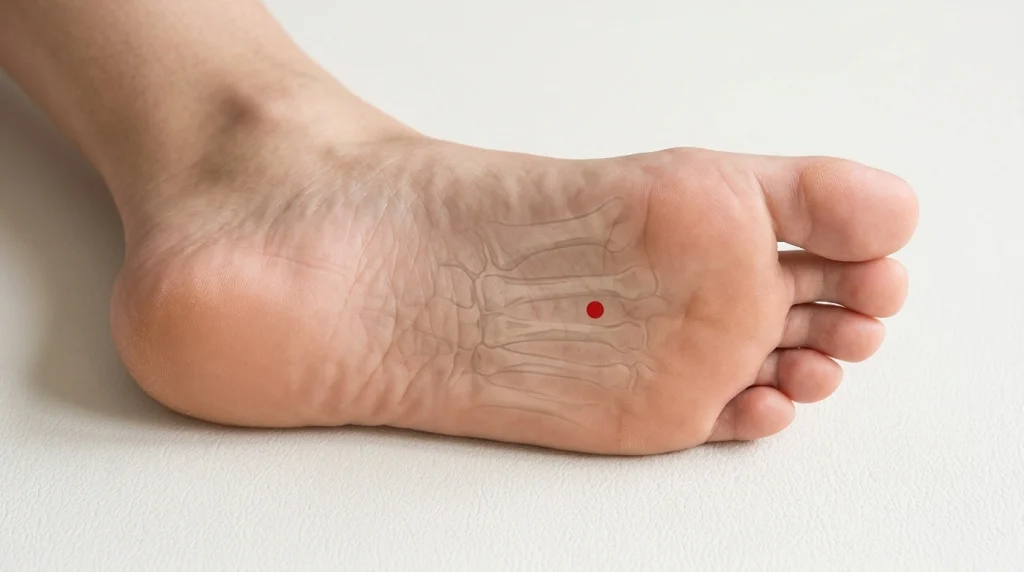
How to find it: curl your toes. Yongquan is the dip that forms on the sole, about one-third of the way from the base of the toes to the heel.
How to press: firm pressure or thumb circles for 1 to 2 minutes on each foot. In TCM, KD1 draws energy downward, which helps when you feel restless or “wired” in bed. Soaking your feet in warm water first makes it more relaxing.
6. Sanyinjiao, SP6 (三阴交, “Three Yin Intersection”)
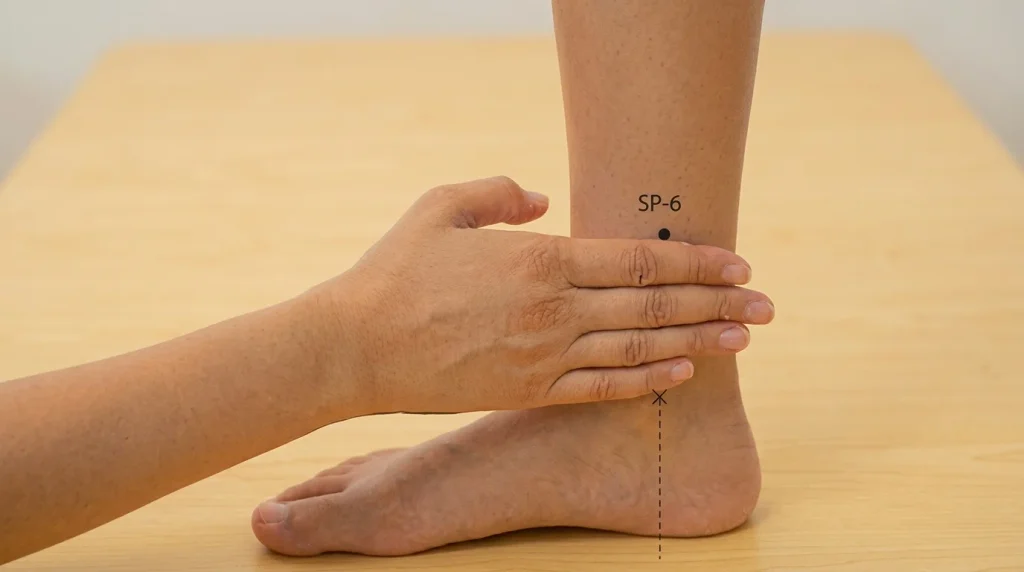
How to find it: place four fingers above the highest point of your inner ankle bone. SP6 is just behind the edge of the shin bone at that level, and it often feels tender.
How to press: firm pressure for 1 to 2 minutes on each leg. SP6 links the Spleen, Liver and Kidney meridians and is commonly used for light sleep and sleep that worsens around the menstrual cycle. Do not use SP6 if you are pregnant.
7. Taichong, LV3 (太冲, “Great Surge”)
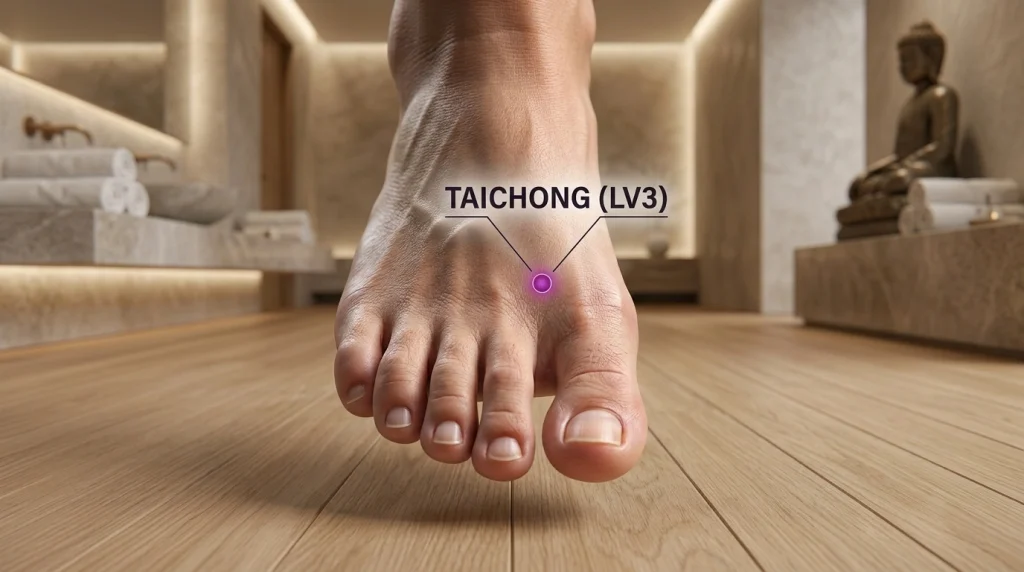
How to find it: run a finger from the web between your big toe and second toe up the top of the foot until it stops in a dip where the two bones meet.
How to press: firm pressure for 1 to 2 minutes on each foot. LV3 is a key point for stress, irritability and tension headaches, which TCM links to Liver qi stagnation.
8. Taixi, KD3 (太溪, “Great Stream”)
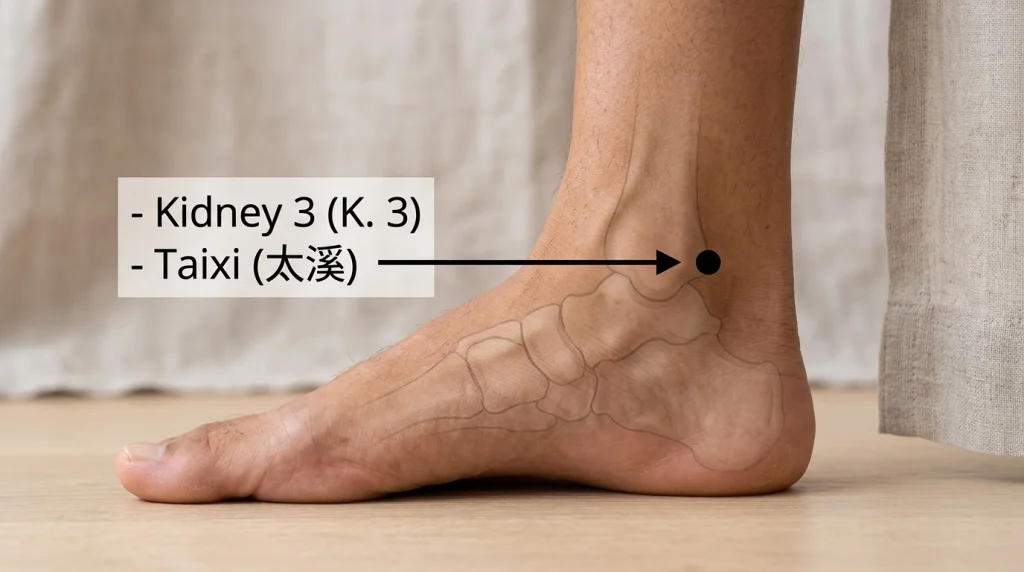
How to find it: on the inner ankle, in the hollow halfway between the tip of the ankle bone and the Achilles tendon.
How to press: gentle to medium pressure for 1 to 2 minutes on each side. KD3 nourishes Kidney Yin in TCM and is often chosen for people who wake at night, feel hot or sweaty at night, or are older.
A 10-minute acupressure routine before bed
You do not need all eight points every night. This routine covers the most useful ones in order, starting about 30 minutes before you want to sleep.
- Minute 0–1: dim the lights, put your phone away, and sit or lie comfortably. Take five slow breaths.
- Minute 1–3: Shenmen (HT7), one minute on each wrist.
- Minute 3–5: Neiguan (PC6), one minute on each arm.
- Minute 5–6: Yintang, one minute, eyes closed.
- Minute 6–8: lie down. Anmian, one minute on each side.
- Minute 8–10: Yongquan (KD1), one minute on each foot, or swap for Taichong (LV3) if stress is the main issue.
Practise every night for at least two weeks before judging whether it helps. Many people feel calmer on the first night, but sleep patterns usually take longer to shift.
Which points suit your type of sleep problem?
TCM recognises several patterns of insomnia (不寐, bù mèi). Matching points to your pattern makes self-care more targeted. A TCM physician confirms the pattern using your tongue and pulse.
| TCM pattern | Typical sleep problem | Other signs | Points to emphasise |
|---|---|---|---|
| Liver fire (肝火扰心) | Hard to fall asleep, mind racing | Irritability, headaches, red eyes, bitter taste | LV3, Anmian, Yintang |
| Heart and Spleen deficiency (心脾两虚) | Wakes easily, lots of dreams, unrefreshed in the morning | Tiredness, poor appetite, pale face, overthinking | HT7, SP6, PC6 |
| Heart and Kidney disharmony (心肾不交) | Wakes at night and cannot fall back asleep | Night sweats, hot palms and soles, palpitations; common around menopause | KD3, KD1, HT7 |
| Phlegm-heat (痰热扰心) | Restless sleep after heavy or late meals | Bloating, heartburn, heavy head | PC6, KD1 |
| Heart and Gallbladder qi deficiency (心胆气虚) | Very light sleep, startled awake by small noises | Timid or anxious, palpitations | HT7, Anmian, Yintang |
What does the research say about acupressure for sleep?
The evidence is promising but limited. Most studies are small, and much of the research on these points uses acupuncture rather than acupressure.
- A 2018 systematic review and meta-analysis in Sleep Medicine Reviews found that acupressure improved sleep quality compared with control groups, while noting the quality of the studies varied (Waits et al., 2018).
- In a randomised trial of breast cancer survivors with persistent fatigue, self-administered relaxing acupressure, including LV3 and Anmian-area points, improved sleep quality compared with usual care (Zick et al., 2016).
- A 2024 trial in 72 hospital patients with burns found that 10 minutes of acupressure on Yintang and Shenmen for three nights lowered anxiety and improved sleep quality compared with sham points.
- A 2018 review of five trials found that stimulating Yintang may reduce anxiety, which can make it easier to fall asleep.
- For acupuncture, a systematic review of randomised trials found it improved sleep quality more than no treatment or sham acupuncture (Cao et al., 2009).
In short, acupressure is a safe, low-cost addition to good sleep habits, not a replacement for proper treatment of chronic insomnia.
Is acupressure safe? Who should be careful
Acupressure is low risk for most adults when pressure stays gentle to moderate. Take extra care, or ask a professional first, if you:
- Are pregnant: avoid SP6 (Sanyinjiao), and also avoid Hegu (LI4) on the hand, which some guides list for stress.
- Bruise easily, take blood thinners, or have a bleeding disorder
- Have a fracture, recent surgery, open wound, rash, varicose veins or infection over a point
- Have diabetes with reduced feeling in the feet, since you may press too hard on KD1, LV3 or KD3
- Are pressing for a young child or a frail older person, who need much lighter pressure
Stop if a point becomes painful, numb or bruised.
Daily habits that make acupressure work better
Acupressure works best on top of a steady sleep routine:
- Keep the same sleep and wake times, including weekends.
- Get morning daylight for 15 to 30 minutes to anchor your body clock.
- Stop screens at least an hour before bed.
- Finish dinner two to three hours before bed, and go easy on spicy, oily food and alcohol at night.
- Avoid coffee and strong tea after early afternoon.
- Keep the bedroom cool, dark and quiet; set the air-conditioner to a comfortable cool temperature.
- In TCM, sleeping before 11 pm protects the body’s natural rest cycle, so aim to be in bed by then.
When to see a doctor or TCM physician
Self-care is a good start, but get professional help if:
- You have trouble sleeping at least three nights a week for three months or longer (the usual definition of chronic insomnia)
- You snore loudly, gasp or stop breathing in your sleep, which can be signs of sleep apnoea
- Poor sleep comes with low mood, constant worry or thoughts of self-harm
- Daytime sleepiness affects driving or work safety
- You rely on sleeping pills and want to reduce them (do this only with your doctor)
How TCM treatment at G&G can help with sleep
If acupressure alone is not enough, a TCM physician can treat the pattern behind your poor sleep. At G&G TCM, this starts with a consultation, including tongue and pulse diagnosis, followed by a plan that may combine acupuncture on points like those above, herbal medicine, and lifestyle advice. Acupuncture is also widely used for stress, a common cause of sleepless nights; read more in our guide to TCM acupuncture for stress.
G&G TCM is open daily from 10 am to 8:30 pm (last appointment 8 pm). Book via WhatsApp at +65 8215 6878 or +65 8168 2062.
FAQs Section
Which acupressure point is best for sleep?
Anmian, behind the ear, and Shenmen (HT7), on the inner wrist crease, are the most commonly used. Many people start with these two and add others based on their sleep problem.
How long should I press each acupressure point for sleep?
Usually 1 to 3 minutes per point, on both sides of the body, with slow, steady breathing.
When is the best time to do acupressure for sleep?
About 30 minutes before bed, or in bed with the lights off. Points like Anmian and Yongquan are easy to do lying down.
How soon will acupressure improve my sleep?
Some people feel calmer after one session, but give it at least two weeks of nightly practice before deciding whether it helps.
Can acupressure replace sleeping pills?
No. It can support better sleep, but chronic insomnia and any change to sleep medication should be managed with a doctor.
Is acupressure safe during pregnancy?
Gentle pressure on points such as Shenmen and Yintang is generally considered low risk, but avoid SP6 and LI4, and check with your doctor or TCM physician first.
Can children and older adults use acupressure for sleep?
Yes, with much lighter pressure and shorter times. Older adults with thin skin, diabetes or blood thinners should press very gently.
What is the difference between acupressure and acupuncture for sleep?
Acupressure uses finger pressure at home; acupuncture uses fine needles applied by a trained physician. Acupuncture has more research behind it for insomnia and can be tailored to your TCM pattern.
References
- Waits A, Tang YR, Cheng HM, Tai CJ, Chien LY. Acupressure effect on sleep quality: a systematic review and meta-analysis. Sleep Medicine Reviews. 2018;37:24–34. Link
- Zick SM, Sen A, Wyatt GK, et al. Investigation of 2 types of self-administered acupressure for persistent cancer-related fatigue in breast cancer survivors: a randomized clinical trial. JAMA Oncology. 2016;2(11):1470–1476. Link
- Effect of acupressure on Yintang and Shenmen points on anxiety and sleep quality in burn patients: a randomized sham-controlled trial. 2024. PMC10759327
- Review of Yintang (EX-HN3) stimulation for anxiety, five randomised trials. 2018. PMC5908420
- Cao H, Pan X, Li H, Liu J. Acupuncture for treatment of insomnia: a systematic review of randomized controlled trials. Journal of Alternative and Complementary Medicine. 2009;15(11):1171–1186. doi:10.1089/acm.2009.0041
- National Center for Complementary and Integrative Health. Acupuncture: Effectiveness and Safety